Eliza Grace Symonds Bell 1809 - 1897
This wonderful bio was taken from Online Safety Trainer (click)
[Original text has no images. See note on images below.]
Eliza Grace Symonds Bell, inscribed Canada in Autumn and Tutelo Heights which is near Brantford, Ont, not dated (she lived in Brantford from 1870 to 1881), size unknown, cropping done by another, likely watercolor & gouache over pencil
Eliza Symonds was a remarkable woman who overcame her deafness to become an accomplished musician and painter. She was also the mother of Alexander Graham Bell, one of the most influential inventors in history.
Eliza Symonds was born on September 21, 1809, in Alverstoke, Hampshire, England. She was the daughter of a naval officer and a descendant of John Hampden, a leader of the English Civil War. She grew up in a cultured and educated family, and showed an early talent for music and art.
All by Eliza Grace - right images look like self portraits, bottom left image is of her mother, Mary White Symonds, according to a note dated 1904 by AGB on back of the image.
Eliza Grace, sketch/print Gateway at Dunfermline Abbey date unknown, about 8” x 10” from a published book of sketches
At the age of 12, Eliza contracted scarlet fever, which left her partially deaf. Despite this setback, she continued to pursue her passions and learned to play the pianoforte and the harp. She also developed a skill for painting miniatures on ivory.
In 1843, Eliza married Alexander Melville Bell, a professor of elocution and phonetics who had developed a system of visible speech for teaching the deaf. They had three sons: Melville James (1845-1870), Alexander Graham (1847-1922), and Edward Charles (1848-1867).
Eliza was a devoted mother who encouraged her sons’ intellectual curiosity and creativity. She taught them to read at an early age and exposed them to various subjects such as literature, science, history, and languages. She also supported their musical interests and often played duets with them on the piano or harp.
Eliza’s deafness worsened over time, but she never let it hinder her communication or social life. She learned to lip-read in several languages and became fluent in French. She also maintained an active correspondence with her friends and relatives. She was incredibly close to her son Alexander Graham Bell, who shared her love for music and art.
Alexander Graham Bell inherited his father’s interest in speech and sound. He became fascinated by the idea of transmitting speech over wires after seeing a demonstration of an electric telegraph. He also wanted to help his mother communicate better with others. He experimented with various devices such as tuning forks, magnets, batteries, wires, reeds, membranes, needles, etc., until he finally invented the telephone in 1876.
Eliza was one of the first people to hear her son’s voice over his new invention. She was amazed by this breakthrough and proud of his achievement. She later wrote to him: “I am so happy that you have been able to give voice to those who cannot speak”[3].
Dunfermline Abbey, Fife, Scotland
Eliza lived long enough to see her son become famous for his invention. She also witnessed him marry Mabel Hubbard (1857-1923), another deaf woman he taught visible speech. Eliza welcomed Mabel into her family and became fond of her grandchildren.
Eliza died on May 10th, 1897, at Washington D.C., at age 87. She was buried next to her husband at Rock Creek Cemetery. Her tombstone bears an inscription that reads: “In memory of Eliza Grace Symonds Bell / Wife / Mother / Friend.”
Eliza Symonds was an extraordinary woman who overcame adversity with grace and dignity. She inspired her son Alexander Graham Bell with her courage and love. She left behind a legacy of artistry and innovation that still resonates today.
References:
number 1 reference: This wonderful bio was taken from Online Safety Trainer (click)
https://www.findagrave.com/memorial/2272/elizabeth-grace-bell
https://commons.wikimedia.org/wiki/File:Eliza_Grace_Symonds.cph.3c22257.jpg
More Images:
I’m lucky to have any images of Eliza Grace’s work to show here much less with their dates, subjects, media, sizes & provenance. If you’ve googled for her work, you know it is hard to find online despite its high quality; despite her reputation as a respected self-supporting working artist - well before her marriage in 1843 at independent minded age of 33! - in the mid-19th century; and, despite, even, her famous son.
If you have work by Eliza Grace or information about her art and you would be kind enough to share images and knowledge, get in touch. If you know of works viewable online or you know of works in collections in private or public hands that I could contact, please get in touch.
landessullivan at gmail com
I believe most of her extant work is in Brantford, Ontario at a little museum run by the town. I believe the works shown here repose there except the Dunfermline Abbey print.
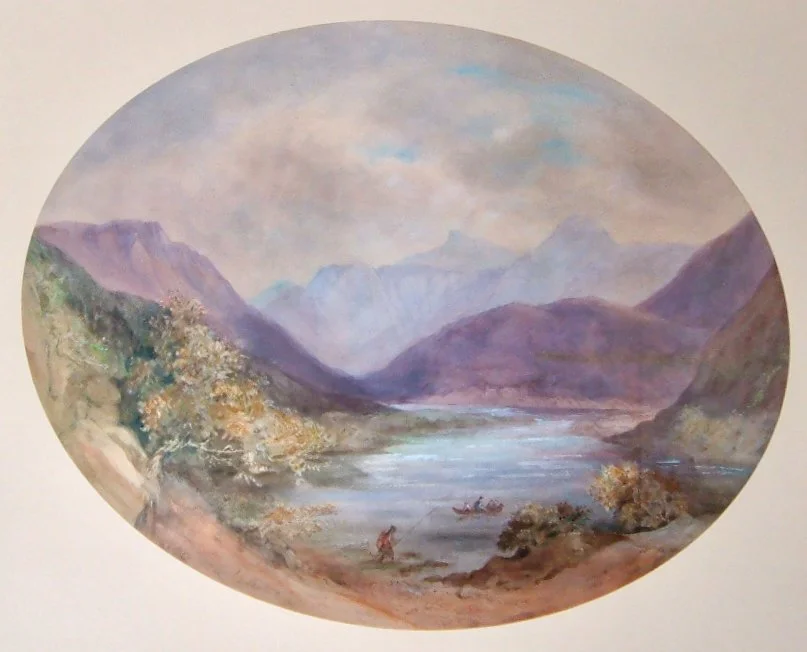
Eliza Grace, watercolor, approx 11” x 17”, no other information available.
Eliza Grace and Alexander Melville Bell lived in Brantford from 1870 to 1881. The town preserves their house as it was. Its claim to fame is being the place in 1874 where AGB got his great epiphany about how the telephone could work.
Eliza Grace is treated as the “mother of.” The museum has never done anything with her artwork in the house or online. Yes, yes, it’s tough to compete against the invention of the telephone, but it was her house!
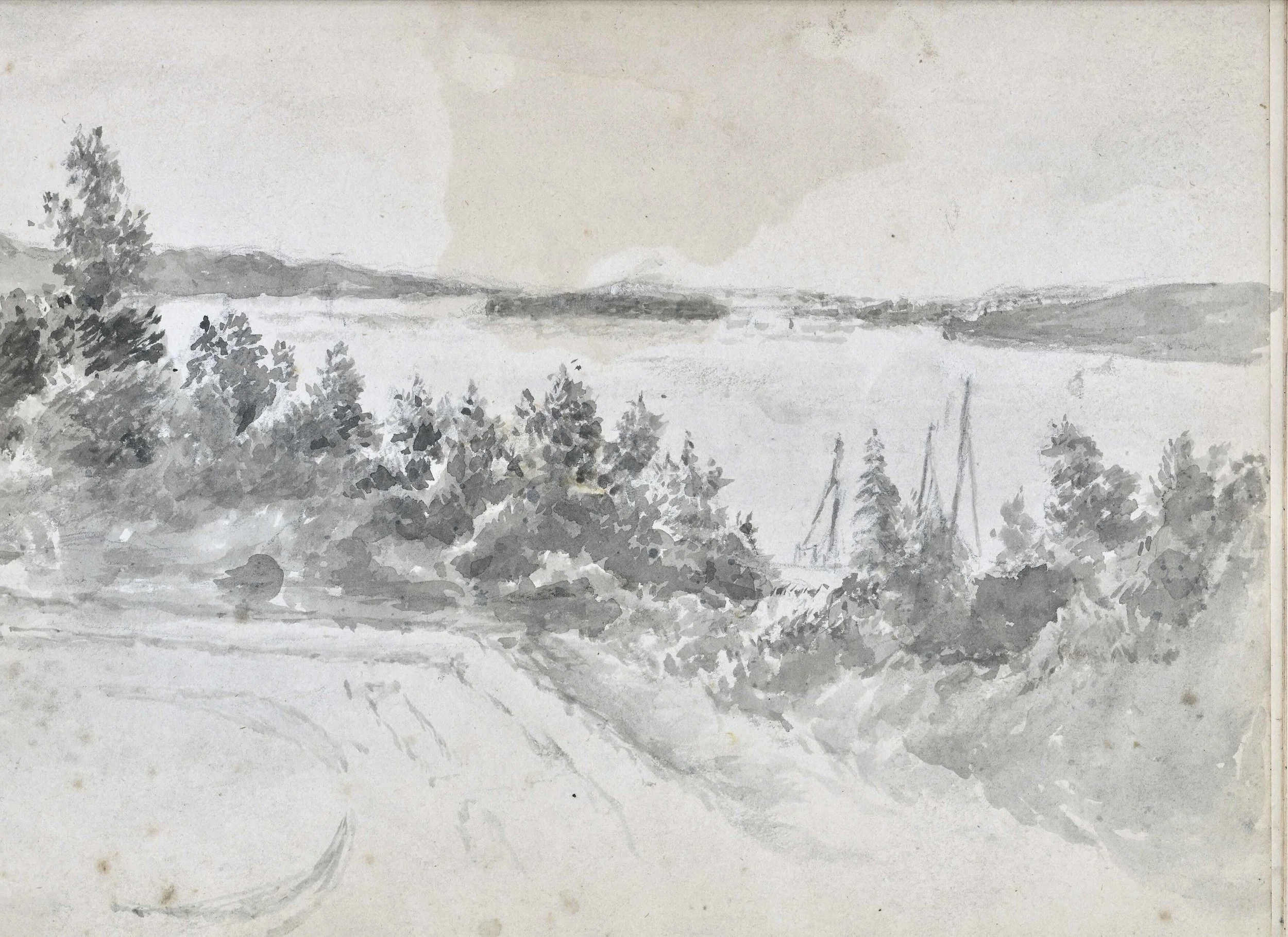
Eliza Grace, ink sketch, around 1890, no other information available other than that it is likely a view from AGB’s Summer home in Nova Scotia, looking across the Bras d’or Lake to the village of Baddeck, sailboats in the foreground right.
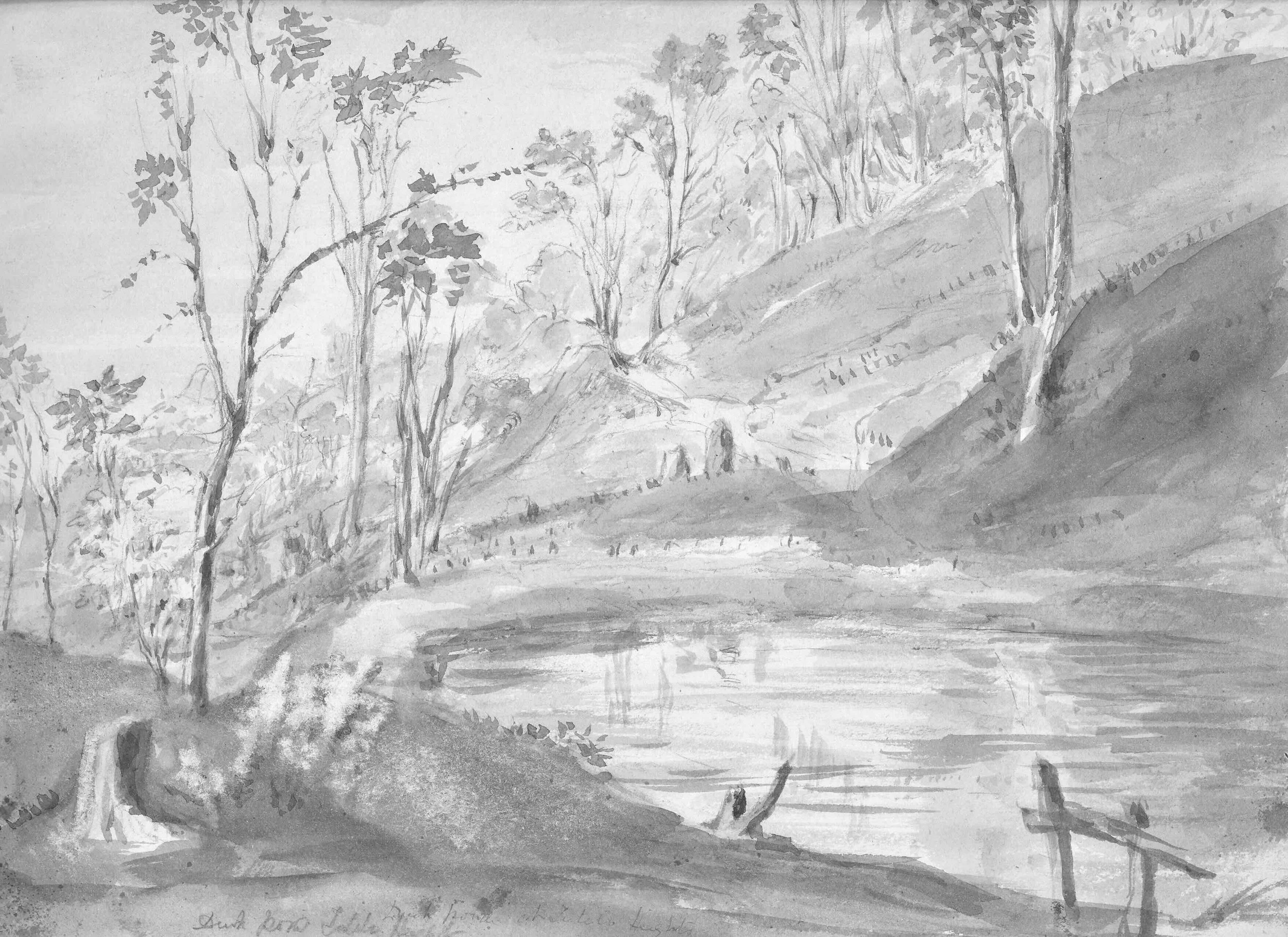
Eliza Grace, ink sketch, inscribed “Duck Pond, Tutelo Heights”, no other information available. The Bells lived in the Tutelo (or Tutela as it is now) Heights in Brantford. They lived there 1870 to 1881.
Eliza Grace, inscribed Champs Elysees Paris, sketchbook page, no other information available
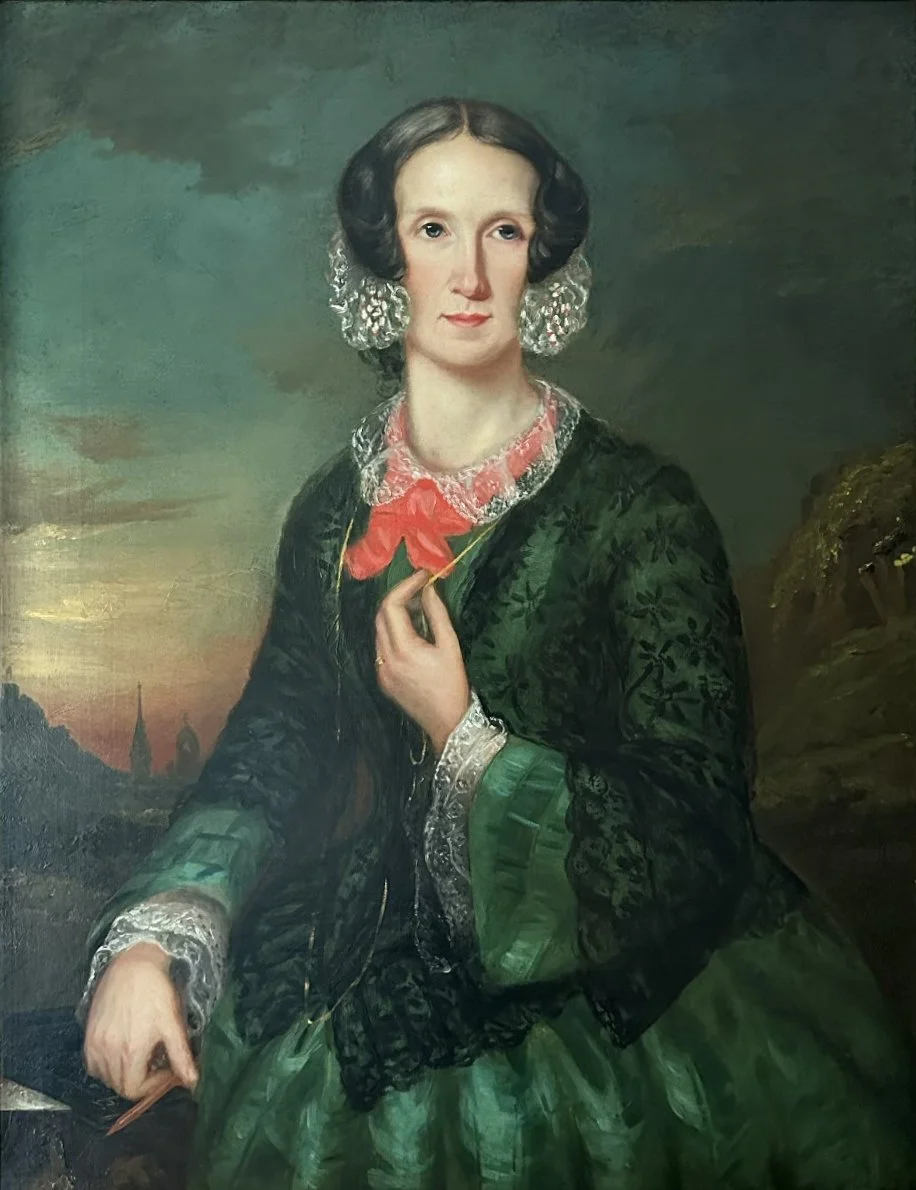
Portrait of Eliza Grace Symonds Bell (reputedly a self-portrait), the mother of Alexander Graham Bell, oil on canvas, 39” x 32” on extended loan to the Bell Homestead in Brantford Ont.
I apologize for including a work of doubtful attribution, but it is the most accomplished work I currently know of that may be by Eliza Grace.
It is thought to be from the 1850s when she was in her forties, married (see ring) and living in Edinburgh. Assuming a good dose of artistic license, the buildings on the left may be Tron Kirk (left) and St Giles looking west along Edinburgh’s High Street. I can’t determine what the rocky landmark is on the right.
Until I discover its provenance, learn more about her work in general and see more of it (even in reproduction), I can’t be certain she painted this. All the other works by her that I have seen are miniatures and small sketches. Some of the former are likely in oil, but the latter are all pencil and/or water media.
The iconography appears to go against her too! The pencil in her right hand and the sketchbook under it suggest an artist of small works and not life-size portraits. I am curious about the long chain or thin necklace. Is it attached to spectacles or a monocle (note the loop shape just beneath her left hand)? By her 40s, she may have needed such for closeup work!
Again, please, if you have work by Eliza Grace or information about her art and you would be kind enough to share images and knowledge, please get in touch. If you know of works viewable online or you know of works in collections in private or public hands that I could contact, again, please get in touch.
landessullivan at gmail com I am the Sullivan and a descendant
Family lore says this painting is by her, but it is not likely any artist could produce a full size oil painting of this polished quality without having done many, many others. I know of no other works of this quality that have been attributed to her. Family lore also says that Eliza Grace sent the painting to one of her 2 brothers who immigrated to Australia. The painting came to AGB in Washington DC after the brother’s death in 1899. Eliza Grace died in 1897. It is possible she gave a small self portrait sketch to her brother who then commissioned a full sized portrait from it. That would make sense of the family’s attribution to her of the larger portrait